Medically Reviewed by Dale Levinsky, MD
Types of Edema
Re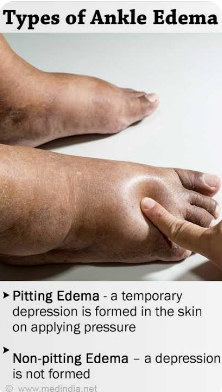 cently, a student asked, “Isn’t all edema really lymphedema?”
What a terrific question!
In Exploring Medical Language, edema is defined as puffy swelling of tissue from the accumulation of fluid. The student who asked the question understood that lymph is fluid from blood plasma that leaks into tissues.
However, not all fluid in edema is lymph.
Edema is the accumulation of excess interstitial fluid, not necessarily lymph. Although lymphatic obstruction can cause lymphedema, most edema results from plasma-derived fluid moving from capillaries into the tissues faster than it can be removed by the venous and lymphatic systems.
The composition of edema fluid depends on the underlying cause:
-
- Most edema consists primarily of interstitial fluid derived from blood plasma that has leaked from capillaries into the tissues. This occurs in conditions such as heart failure, kidney disease, venous insufficiency, and hypoalbuminemia.
-
- Lymphedema is a specific type of edema caused by impaired lymphatic drainage. In this case, the accumulated fluid is rich in proteins because lymph is not being adequately returned to the circulation. Lymphedema is often classified as non-pitting edema.
-
- Pulmonary edema involves fluid accumulation within the lungs, while cerebral edema involves excess fluid within brain tissue. These fluids are not typically described as lymph but rather as fluid that has moved from the vascular compartment into the affected tissues.
Edema is classified in a couple of different ways, including by location such as peripheral edema, pulmonary edema, and cerebral edema. With a quick scan of the ICD-11 Coding Tool, I see many other types, including ankle, retinal, corneal, and so forth. It can also be described as pitting and non-pitting.
Pitting edema occurs when pressure applied to the swollen tissue leaves a temporary indentation, indicating that fluid can be displaced within the tissues, whereas non-pitting edema does not leave an indentation because the swelling is associated with protein-rich fluid, lymphatic obstruction, or tissue changes that prevent the fluid from shifting easily.
I hope this post supports your understanding of edema and the different types of fluid that can collect in tissue. May your studies go well!
Until next time,
Danielle
Danielle LaFleur Brooks is the Coordinator and Faculty of Teaching and Learning for Allied Health and Science at the Community College of Vermont, and the author of the textbooks Exploring Medical Language and Basic Medical Language.
Reference List
Dorland. (2019). Dorland’s illustrated medical dictionary (33rd ed.). Elsevier.
International Classification of Diseases, 11th revision. (2026). World Health Organization. https://icd.who.int/en/
LaFleur, D. S., Levinsky, D., & LaFleur-Brooks, M. (2026). Exploring medical language: A student-directed approach. Elsevier.
OpenAI. (2026, July 30). ChatGPT response to questions about the types of edema [Large language model]. Microsoft Copilot. https://copilot.microsoft.com.
Smith, C. C. (2025). Clinical manifestations and evaluation of edema in adults. UpToDate. Retrieved July 30, 2026, from https://www.uptodate.com/contents/clinical-manifestations-and-evaluation-of-edema-in-adults
Venes, D. (Ed.). (2021). Taber’s cyclopedic medical dictionary (24th ed.). F.A. Davis.
WellyHub. (2025, November 14). What are the different types of edema? A comprehensive guide. WellyHub. https://wellyhub.com/what-are-the-different-types-of-edema
WellyHub. (2025, November 15). How do you categorize edema? A guide to understanding types. WellyHub. https://wellyhub.com/how-do-you-categorize-edema-understanding-the-different-types-of-swelling