What does orth/o/pedics have to do with bones?
During a recent class meeting, the combining form orth/o was incorrectly defined as “bone.” Given the modern meaning of orthopedics, it is easy to understand why. Let’s take a moment to review definitions of combining forms, then consider the evolution (etymology) of the term:
| Combining Form | Definition |
| orth/o | straight |
| oste/o | bone |
Evolution of the Term Orthopedics
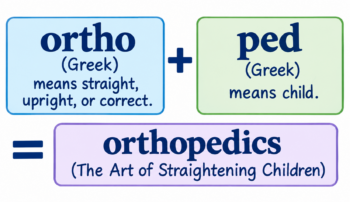 The term orthopedics was first introduced in 1741 by the French physician Nicolas Andry de Bois-Regard in his book Orthopaedia, or the Art of Correcting and Preventing Deformities in Children.
He coined the word from the Greek roots (shown here as combining forms) orth/o, derived from the Greek word “orthos,“ meaning straight, upright, or correct, and ped/o, derived from the Greek word “paidion,” meaning child. He explained that he created the term to describe the methods used to prevent and correct physical deformities in children.
The original meaning of orthopaedia referred to “the art of straightening children” or “the prevention and correction of deformities in children.” Over time, the specialty expanded beyond children to include the diagnosis, treatment, and prevention of disorders and injuries affecting the musculoskeletal system in people of all ages. As a result, the modern term orthopedics refers to the care of bones, joints, muscles, tendons, and ligaments, while retaining its linguistic roots in restoring proper alignment and function (Andry, 1743/1741; Kohler, 2010).
In the textbooks Exploring Medical Language and Basic Medical Language, the term orthopedics is classified as “NOT Built from Word Parts” because the current meaning of the term can no longer be easily understood from the meaning of its word parts.
Also, see this article for a good explanation of how the combining form orth/o is used in other terms: What does the medical root “orth/o” mean?
I hope this post helps you understand how the meaning of medical terms changes over time. May your studies go well!
Until next time,
Danielle
Danielle LaFleur Brooks is the Coordinator and Faculty of Teaching and Learning for Allied Health and Science at the Community College of Vermont, and the author of the textbooks Exploring Medical Language and Basic Medical Language.
Read Other Teaching and Learning Tips >Reference List
Andry de Bois-Regard, N. (1743). Orthopaedia: Or, the art of correcting and preventing deformities in children (English translation of the 1741 French edition). London.
BiologyInsights Team. (2025, November 29). What does the medical root “orth/o” mean? Biology Insights.
Dorland. (2019). Dorland’s illustrated medical dictionary (33rd ed.). Elsevier.
Kohler R. (2010). Nicolas Andry de Bois-Regard (Lyon 1658–Paris 1742): The inventor of the word “orthopaedics” and the father of parasitology. Journal of Children’s Orthopaedics, 4(4), 349-355. https://doi.org/10.1007/s11832-010-0255-9
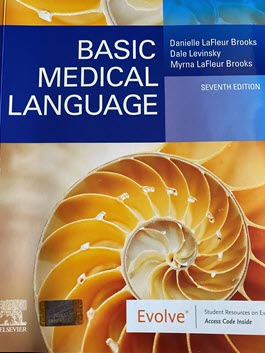
LaFleur Brooks D., Levinsky D., & LaFleur Brooks M. (2024). Basic Medical Language: A student-directed approach. Elsevier.
LaFleur Brooks D, Levinsky D, & LaFleur Brooks M. (2026). Exploring Medical Language: A student-directed approach. Elsevier.
Medically Reviewed by Dale Levinsky, MD