Medical terms with the same meaning are common in medical language and result from language evolving over time and across cultures. Most terms are interchangeable, though one is sometimes used more frequently, usually depending on geographical region and/or medical specialty.
Subcutaneous and hypodermic provide such an example, and they are used distinctly.
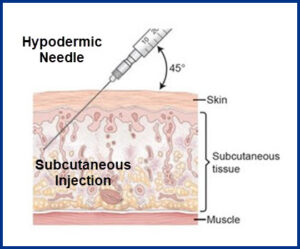
A subcutaneous injection to administer drugs beneath the skin is given with a hypodermic needle.
In other words, hypodermic describes the needle, while subcutaneous describes the injection site (other types include intramuscular and intradermal). A hypodermic needle is also used to administer IV fluids and to withdraw blood (venipuncture).
Memory tip:
- Hypodermic explains How (hypodermic needle).
- Subcutaneous Shows where (subcutaneous injection).
Linguistically, I can give some insight that may help (or may add complication). Generally,
Latin terms and word parts describe body structures. Cutane/o is Latin in origin, so subcutaneous points to the needle’s anatomic location: under the skin’s surface, in the subcutaneous layer.
Greek terms and word parts generally describe diseases, conditions, and treatments. Derm/o is Greek in origin, so hypodermic describes the needle, the tool used in the “treatment.”
Transdermal and percutaneous, meaning through the skin, provide another example. Both can describe administering medications absorbed through the skin to deeper levels, including into the bloodstream.
Transdermal most often describes this route, while percutaneous can also describe needle punctures or small incisions through the skin to access organs for procedures and treatments.
Memory tip:
- Percutaneous, think Performing – like performing a procedure through the skin
- Transdermal, think Transit – like the skin as a mode of transportation to deliver medicine
I hope this post helps you differentiate how to use the terms featured in this blog. May your studies go well!
Until next time,
Danielle
Read Other Teaching and Learning Tips >Danielle LaFleur Brooks is the Coordinator and Faculty of Teaching and Learning for Allied Health and Science at the Community College of Vermont, and the author of the textbooks Exploring Medical Language and Basic Medical Language.
Reference List
Barta, A. (2017). Differentiating Procedure Approach in ICD-10-PCS: Fifth Character Captures Specificity. The American Health Information Management Association. Retrieved from http://library.ahima.org/doc?oid=94033#.WckZ7vWcE2w.
Dorland’s Illustrated Medical Dictionary, 32e. (2012). Philadelphia: Saunders/Elsevier.
LaFleur Brooks, D. et al. (2019). Basic Medical Language, 6e. St. Louis: Elsevier
LaFleur Brooks, D. et al. (2020). Exploring Medical Language, 11e. St. Louis: Mosby/Elsevier.
Image Source: LaFleur Brooks, D. et al. (2020). Exploring Medical Language, 11th edition. St. Louis: Mosby.