
Taking Charge of Your Flashcards
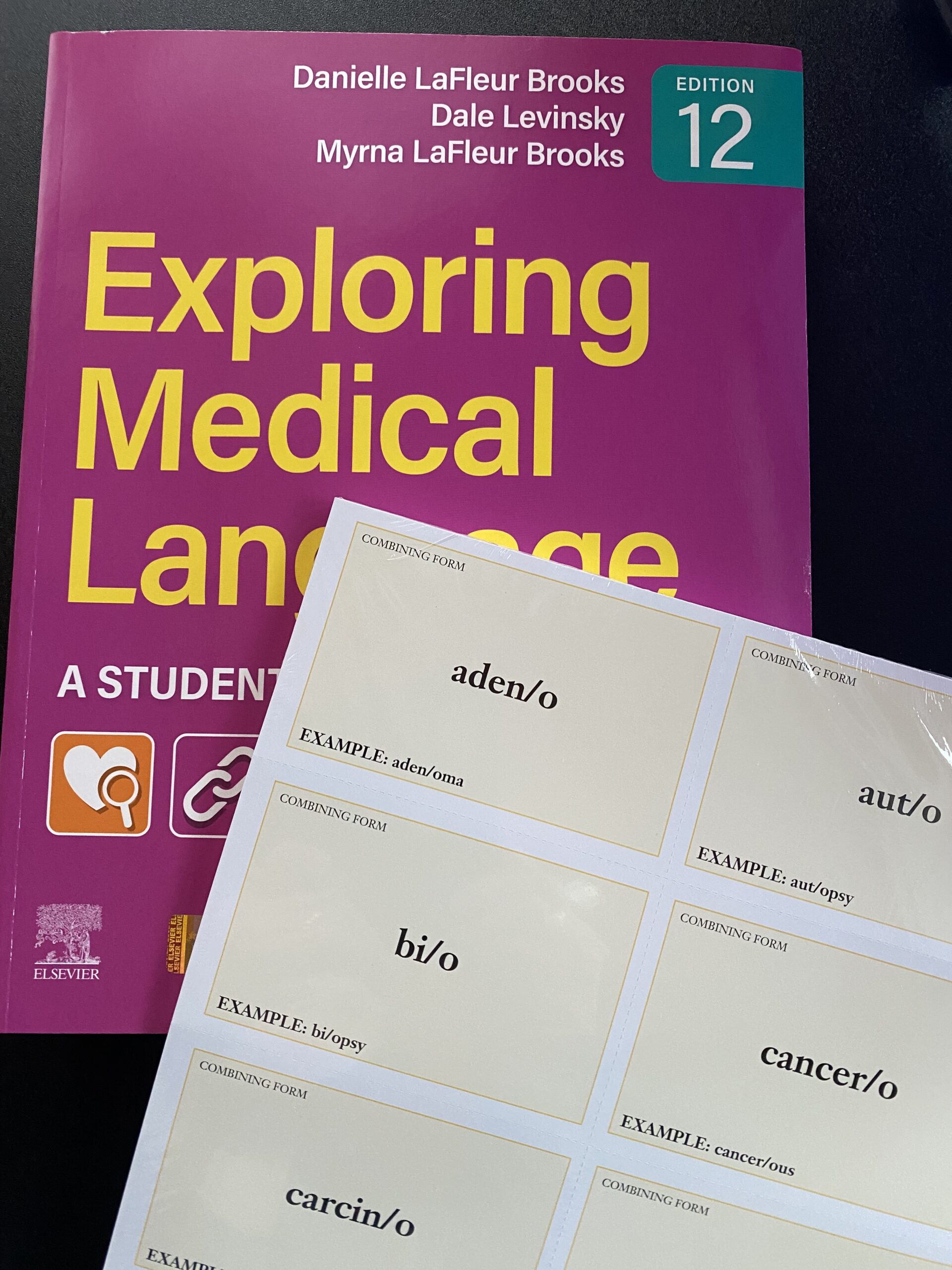
If you’re taking or teaching medical terminology this spring, you’ll likely use up to 600 paper flashcards with your textbook.
Six Tips for Managing Your Paper Flashcards
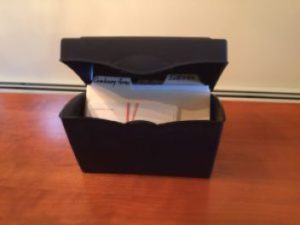
1. Get a nice container
Keeping your flashcards in a well-organized holder gives a more organized impression and thus increases the likelihood that you will use them for study. Furthermore, when they are in a container, they are easy to transport and locate.
2. Group flashcards by prefixes, suffixes, and combining forms
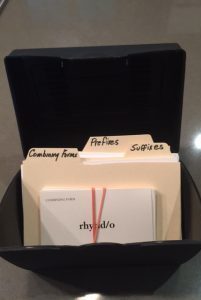
 Separate the flashcards for a chapter into prefixes, suffixes, and combining forms. Use a simple rubber band to keep them together. As you are introduced to more prefixes and suffixes, add the new flashcards to their group.
Since there are so many combining form flashcards, further separate them by chapter or body system.
You may want to use dividers in the container to keep the cards organized.
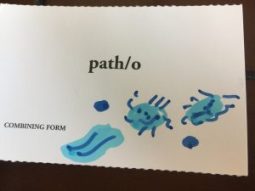
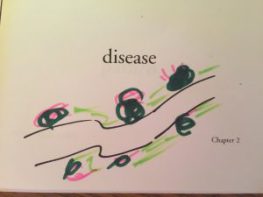
3. Personalize flashcards by drawing pictures
Add drawings to your flashcards to help you remember the word parts better. Be silly and have fun with this one. Remember to use color. As in the example below, the images are very personal and may speak to you alone.
4. Speak your answers
If you are lucky enough to have a study partner, you are probably saying the word parts out loud. If studying by yourself, it is tempting to say them silently. Say the word part out loud if studying by yourself or with a partner.
5. Use both sides of the flashcard
Studying flashcards from both sides, the word part side and the definition side, helps build strong neural pathways that can easily track the answer in both directions.
6. Create a ‘know’ pile and a ‘no’ pile
Suppose you are working with 30 new word part flashcards for the cardiovascular chapter. If you find you know the answer (you got it correct), place the flashcard on the ‘know’ pile. If you find you have not memorized the meaning of the word part yet, place the flashcard on the ‘no’ pile. Work with the ‘no’ pile until it is empty. Start over with the 30 flashcards and see how you do.
Most students do not have sufficient time to learn the language of medicine. With that in mind, I hope these tips help you use your time to learn word parts quickly and effectively.
Myrna LaFleur Brooks is the coauthor of the textbooks, Exploring Medical Language and Basic Medical Language.


0 Responses
I recommend grouping the flashcards by chapters in the book.